
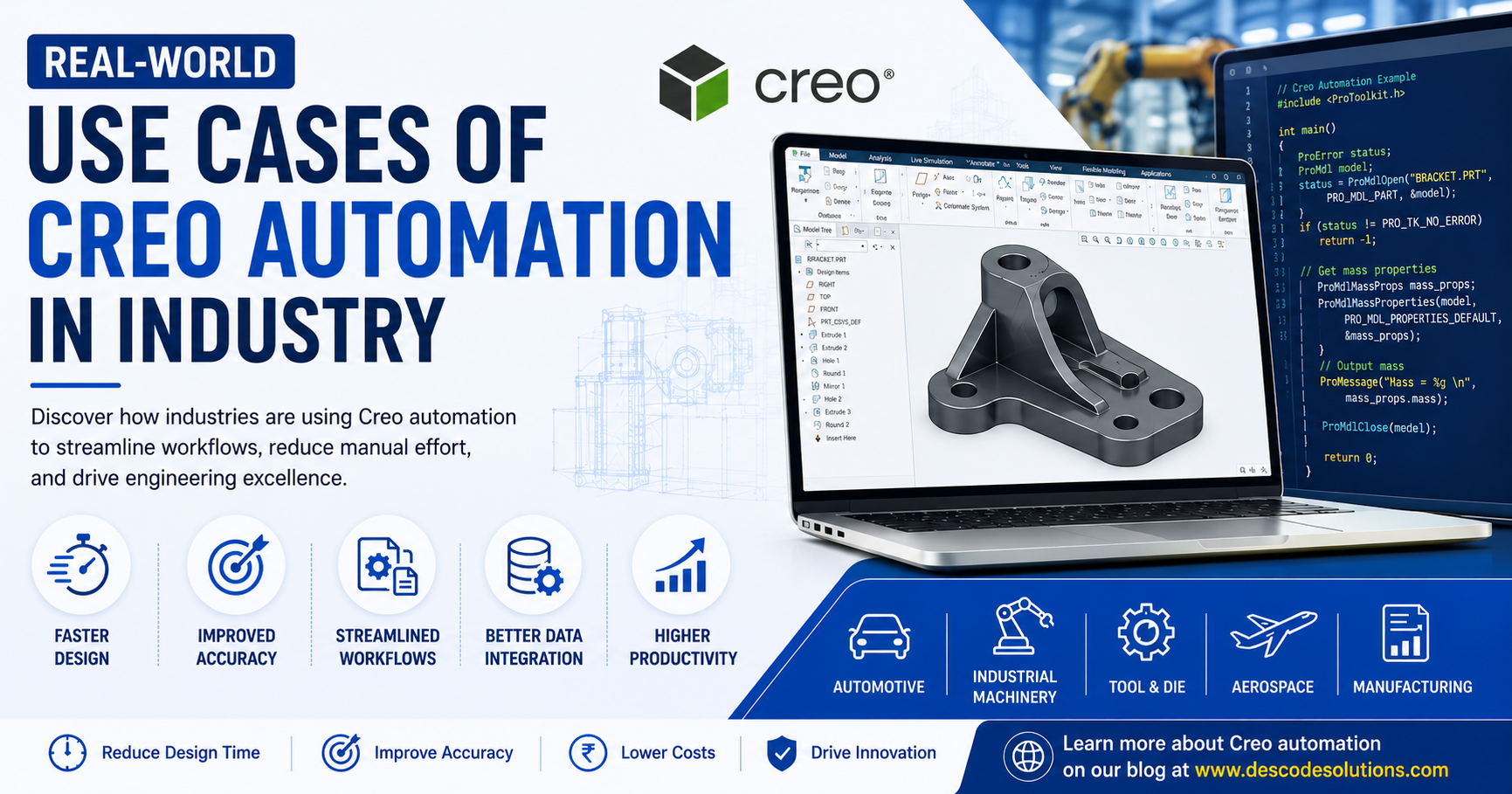
Real-World Use Cases of Creo Automation in Industry
Discover how companies are using Creo automation to improve productivity, reduce design time, and build smarter engineering workflows. This blog explores real-world industrial applications of Creo automation and why it is becoming an essential skill for modern engineers.
5/7/20262 min read
Overview
In today’s engineering world, speed, accuracy, and efficiency are critical. Traditional design methods often involve repetitive tasks, manual data entry, and time-consuming model updates. This is where Creo automation creates real business value.
Using Creo APIs, macros, and custom automation tools, companies can streamline engineering workflows, reduce manual effort, and improve design consistency.
From automotive components to industrial machinery, Creo automation is helping organizations transform the way they design and develop products.
What is Creo Automation?
Creo automation is the process of using programming tools, APIs, and scripts to automate tasks inside Creo.
With automation, engineers can:
Eliminate repetitive manual operations
Build custom design tools
Standardize engineering workflows
Integrate CAD with business systems
Improve speed and accuracy
This allows teams to focus more on engineering innovation rather than repetitive execution.
Real-World Use Cases of Creo Automation
1. Automated Part Modeling
One of the most common applications of Creo automation is automatic part generation.
Instead of creating similar parts manually every time, engineers can build automation scripts that generate models based on predefined parameters.
Industry Benefits:
✔ Faster part creation
✔ Reduced modeling errors
✔ Consistent design standards
✔ Improved engineering efficiency
This is widely used in automotive and manufacturing industries.
2. Parametric Design Automation
Many industries use products with multiple size variations or configurations.
Creo automation can automatically generate design variants by changing input parameters such as:
Length
Diameter
Material specifications
Hole positions
Feature dimensions
Industry Benefits:
✔ Faster product customization
✔ Reduced engineering effort
✔ Better design flexibility
This is commonly used in machinery and product design sectors.
3. Drawing and Documentation Automation
Creating engineering drawings manually takes significant time.
With Creo automation, companies can automatically:
Generate 2D drawings
Create dimensions and annotations
Update BOM data
Export manufacturing documentation
Industry Benefits:
✔ Faster documentation
✔ Improved accuracy
✔ Reduced drafting effort
This is highly useful in manufacturing environments.
4. Tool and Fixture Design Automation
Tooling teams often work with similar design patterns.
Creo automation helps by automating:
Standard component placement
Hole creation
Plate generation
Assembly positioning
Industry Benefits:
✔ Reduced tool design time
✔ Standardized workflows
✔ Faster production support
This is widely used in tool rooms and die manufacturing.
5. Assembly Automation
Large assemblies can require repetitive positioning and constraint creation.
Using automation, engineers can:
Insert components automatically
Apply assembly constraints
Validate interference
Generate assembly reports
Industry Benefits:
✔ Faster assembly creation
✔ Better design consistency
✔ Reduced manual effort
This is valuable in aerospace and industrial equipment design.
6. Data Extraction and Reporting
Engineering teams often need model data for reporting and analysis.
Creo automation can extract:
Mass properties
Material information
Dimensions
Custom parameters
Manufacturing data
Industry Benefits:
✔ Faster reporting
✔ Better decision-making
✔ Easy data integration
This supports design and management teams alike.
7. Integration with PLM and ERP Systems
Many enterprises integrate Creo with PLM and ERP systems.
Automation helps synchronize:
Part numbers
Revision data
Material records
Project documentation
Industry Benefits:
✔ Better data management
✔ Reduced manual data entry
✔ Improved process control
This is critical for large organizations.
Why Industries Are Investing in Creo Automation
Companies adopting Creo automation often achieve:
✔ Faster project delivery
✔ Reduced design costs
✔ Improved product quality
✔ Higher engineering productivity
✔ Better process standardization
As product complexity increases, automation becomes a strategic advantage.
Future Scope of Creo Automation
With digital engineering and AI-driven workflows growing rapidly, Creo automation will continue to expand across industries.
Engineers who learn Creo APIs, customization, and automation development will have strong career opportunities in the future.
Conclusion
Creo automation is no longer just an advanced skill—it is becoming an essential part of modern engineering. From automated modeling to enterprise integration, real-world applications are transforming industries every day.
For students and professionals, learning Creo automation can open doors to exciting career opportunities and help build future-ready engineering skills.
Contact Us
💼 At Descode Solutions, we specialize in:
✔ CATIA & NX Automation Training
✔ Real-time Industry Projects
✔ CAD Customization & API Development
📈 Learn smarter. Automate faster. Accelerate your career in CAD automation.
📩 Looking to master Creo automation or build custom engineering solutions? Connect with us today!
📞 Phone: +91 9544 123 321
🌐 www.descodesolutions.com
📧 info@descodesolutions.com
CAD Automation Training
Expert CAD Automation training for professionals and students
OUR COURSES
Contact
info@descodesolutions.com
(+91) 9544 123 321
Copyright © 2026 Descode Solutions LLP
NX Customization
CATIA Customization
AutoCAD Customization
Solidworks Customization
Solid Edge Customization
Revit Customization
Inventor Customization
Creo Customization