
Industry Use Cases of Solid Edge Automation
Discover how companies across various industries use Solid Edge automation to improve productivity, reduce design time, eliminate repetitive tasks, and accelerate product development. Learn the most common real-world applications of Solid Edge automation and why it is becoming essential in modern engineering workflows.
6/11/20263 min read
Introduction
In today's competitive engineering landscape, organizations are constantly looking for ways to improve efficiency, reduce costs, and accelerate product development. Engineers often spend valuable time performing repetitive tasks such as creating models, generating drawings, updating assemblies, and managing design data.
As projects become larger and more complex, manual processes can lead to delays, inconsistencies, and increased engineering costs.
This is where Solid Edge Automation provides significant value.
Using the Solid Edge API and custom automation tools, companies can automate repetitive engineering activities, streamline workflows, and improve overall productivity. From manufacturing and automotive design to industrial equipment development, Solid Edge automation is helping organizations work smarter and deliver projects faster.
What is Solid Edge Automation?
Solid Edge Automation involves using the Solid Edge API and programming tools to automate tasks within Solid Edge.
Automation solutions can:
✔ Create and modify models automatically
✔ Generate drawings and documentation
✔ Update design parameters
✔ Process multiple files in batches
✔ Extract engineering data
✔ Integrate with business systems
The goal is to reduce manual effort while improving accuracy and efficiency.
Why Industries Are Adopting Solid Edge Automation
Many organizations are implementing automation because it helps:
Reduce engineering hours
Improve design consistency
Minimize human errors
Accelerate project delivery
Increase productivity
Standardize workflows
As a result, engineers can focus more on innovation and problem-solving rather than repetitive tasks.
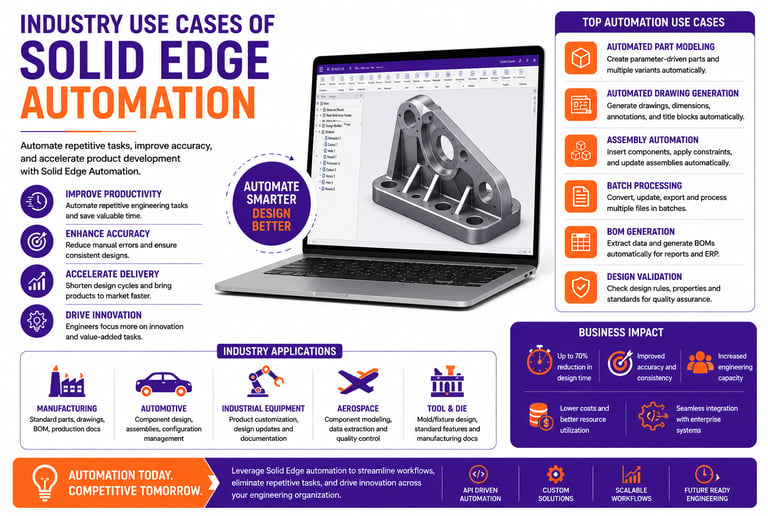
Industry Use Cases of Solid Edge Automation
1. Automated Part Modeling
One of the most common applications of Solid Edge automation is automatic part creation.
Instead of manually modeling similar components repeatedly, engineers can create parameter-driven templates.
Example
A manufacturing company produces brackets in multiple sizes.
Using automation:
✔ Enter dimensions
✔ Generate the model automatically
✔ Create multiple design variants instantly
This significantly reduces modeling time.
2. Automated Drawing Generation
Creating engineering drawings manually can be time-consuming.
Solid Edge automation can automatically generate:
Drawing views
Dimensions
Annotations
Title blocks
Revision information
Benefits
✔ Faster documentation
✔ Improved consistency
✔ Reduced drafting effort
3. Assembly Automation
Large assemblies often contain hundreds or thousands of components.
Automation can help:
Insert components automatically
Apply assembly constraints
Update assemblies
Validate component relationships
This reduces engineering effort and improves assembly management.
4. Batch Processing of CAD Files
Many companies need to process large numbers of CAD files regularly.
Automation can perform batch operations such as:
File conversion
Drawing updates
Property updates
PDF generation
Example
Exporting hundreds of drawings to PDF with a single click.
5. BOM Generation
Generating Bills of Materials manually can be labor-intensive and prone to errors.
Solid Edge automation can:
✔ Extract assembly data
✔ Generate BOM reports automatically
✔ Export data to Excel or ERP systems
This improves accuracy and saves time.
6. Design Validation and Quality Checks
Automation can verify whether models comply with company standards.
Examples include checking:
Missing properties
Naming conventions
Material assignments
Design rules
This helps maintain design quality and consistency.
7. Product Configuration Automation
Many companies manufacture configurable products.
Examples include:
Storage systems
Industrial equipment
Machinery
Consumer products
Automation allows engineers to generate product variants automatically based on customer requirements.
8. Engineering Data Extraction
Organizations often need engineering data for reporting and analysis.
Automation can extract:
Part numbers
Material information
Mass properties
Custom attributes
This data can then be used in reports, ERP systems, or manufacturing workflows.
9. Manufacturing Documentation
Automation helps generate manufacturing-ready documentation quickly.
Outputs may include:
PDF drawings
DXF files
STEP files
Production reports
This improves communication between design and manufacturing teams.
10. Integration with Business Systems
Solid Edge automation can integrate with:
ERP Systems
PLM Systems
Databases
Manufacturing Software
This enables seamless information flow throughout the organization.
Industry Applications
Manufacturing Industry
Automation is used for:
Standard component generation
Drawing automation
BOM creation
Production documentation
Automotive Industry
Applications include:
Vehicle component design
Assembly automation
Configuration management
Design validation
Industrial Equipment Industry
Companies automate:
Product customization
Design updates
Documentation generation
Aerospace Industry
Automation supports:
Component modeling
Data extraction
Documentation management
Quality control processes
Tool & Die Industry
Automation helps with:
Mold design
Fixture design
Standard feature creation
Manufacturing documentation
Benefits of Solid Edge Automation
Organizations implementing Solid Edge automation often experience:
Faster Design Cycles
Projects move from concept to production more quickly.
Increased Productivity
Engineers spend less time on repetitive work.
Reduced Errors
Automation ensures consistent execution of tasks.
Better Standardization
Company standards are applied automatically.
Cost Savings
Reduced engineering effort lowers project costs.
Real-World Impact
Many organizations report significant improvements after implementing automation:
✔ Reduced design time by up to 70%
✔ Faster drawing generation
✔ Improved documentation accuracy
✔ Reduced manual engineering effort
✔ Increased project capacity
The exact benefits depend on workflow complexity and automation scope.
Future of Solid Edge Automation
The future of engineering automation continues to evolve with:
✔ Artificial Intelligence (AI)
✔ Smart Engineering Systems
✔ Digital Twins
✔ Cloud-Based Automation
✔ Intelligent Manufacturing
Companies investing in automation today are building a strong foundation for future innovation.
Career Opportunities
As adoption grows, demand for professionals with Solid Edge automation skills continues to increase.
Popular roles include:
Solid Edge Automation Engineer
CAD Automation Engineer
Design Automation Engineer
CAD Customization Developer
Engineering Software Developer
Combining CAD expertise with programming skills can create excellent career opportunities.
Conclusion
Solid Edge automation is transforming the way companies design, document, and manage engineering projects. From automated modeling and drawing generation to BOM creation and enterprise integration, automation helps organizations improve productivity, reduce costs, and accelerate product development.
As industries continue embracing digital engineering, Solid Edge automation will play an increasingly important role in building efficient and scalable design workflows.
Contact Us
💼 At Descode Solutions, we specialize in:
✔ Solid Edge Automation & Customization
✔ CATIA & NX Automation Training
✔ Real-time Industry Projects
✔ CAD Customization & API Development
📈 Learn smarter. Automate faster. Accelerate your career in CAD automation.
📩 Looking to implement Solid Edge automation or build automation skills? Connect with us today!
📞 Phone: +91 9544 123 321
🌐 www.descodesolutions.com
📧 info@descodesolutions.com
CAD Automation Training
Expert CAD Automation training for professionals and students
OUR COURSES
Contact
info@descodesolutions.com
(+91) 9544 123 321
Copyright © 2026 Descode Solutions LLP
NX Customization
CATIA Customization
AutoCAD Customization
Solidworks Customization
Solid Edge Customization
Revit Customization
Inventor Customization
Creo Customization