CAD Automation in Aerospace Design
Discover how CAD automation is transforming aerospace engineering by improving design accuracy, reducing development time, and optimizing complex engineering workflows. Learn why automation has become essential in modern aerospace product development.
5/21/20262 min read
Overview
The aerospace industry is one of the most advanced engineering sectors in the world. Aircraft and aerospace components require extreme precision, strict quality standards, and highly complex design processes.
Traditional CAD workflows alone are often not enough to manage the growing complexity of aerospace engineering projects. This is where CAD automation plays a major role.
By combining CAD software with programming, APIs, and intelligent automation tools, aerospace companies can improve productivity, reduce manual work, and accelerate product development.
Today, CAD automation is widely used across aircraft design, structural engineering, manufacturing, simulation, and product lifecycle management.
What is CAD Automation in Aerospace?
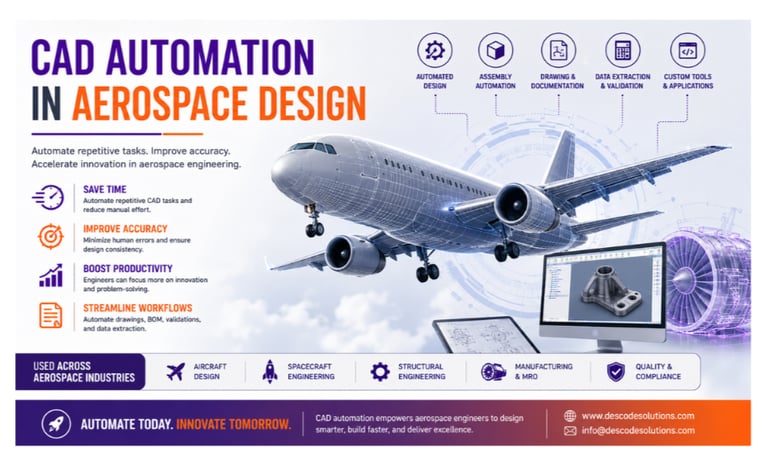
CAD automation in aerospace refers to using software programming and APIs to automate repetitive design and engineering tasks inside CAD systems.
Instead of manually performing every operation, engineers can create automation tools that:
Generate models automatically
Update assemblies instantly
Create engineering drawings
Validate design parameters
Extract manufacturing data
Automate repetitive workflows
This helps aerospace companies save time while maintaining high engineering accuracy.
Why Aerospace Industries Need CAD Automation
Aerospace projects involve thousands of components, assemblies, and engineering calculations.
Manual workflows often create challenges such as:
Long development cycles
Repetitive design modifications
Human errors
Complex configuration management
Time-consuming documentation
CAD automation helps solve these problems efficiently.
Key Benefits:
✔ Faster product development
✔ Improved design consistency
✔ Reduced engineering errors
✔ Better workflow efficiency
✔ Increased productivity
Common Applications of CAD Automation in Aerospace
1. Automated Aircraft Component Design
Engineers can automate the creation of standard aerospace parts such as:
Brackets
Panels
Structural frames
Fastener layouts
Automation reduces repetitive modeling work significantly.
2. Assembly Automation
Aircraft assemblies contain thousands of interconnected components.
Automation helps engineers:
✔ Position components automatically
✔ Update assembly structures
✔ Manage large assemblies efficiently
This improves overall design management.
3. Drawing and Documentation Automation
Aerospace projects require extensive technical documentation.
Automation can generate:
Engineering drawings
BOM reports
Manufacturing documents
Inspection reports
This reduces manual drafting effort.
4. Parameter-Based Design Automation
Engineers can create intelligent models that update automatically based on predefined parameters.
For example:
Changing wing dimensions can automatically update connected structures and assemblies.
5. Data Extraction and Validation
Automation tools can extract:
Mass properties
Material details
Dimensions
Design metadata
This improves design verification and manufacturing readiness.
CAD Software Commonly Used in Aerospace Automation
Popular aerospace CAD platforms include:
CATIA
Siemens NX
Creo
These platforms provide advanced APIs for enterprise-level customization and automation.
Programming Languages Used in Aerospace CAD Automation
Engineers commonly use:
C#
C++
Python
VB.NET
Java
These languages help create professional automation applications and engineering tools.
Real-World Benefits for Aerospace Companies
Reduced Design Time
Automation helps engineers complete repetitive tasks much faster.
Improved Engineering Accuracy
Automated workflows reduce manual mistakes.
Better Standardization
Design rules and processes become more consistent.
Faster Product Modifications
Changes can be applied automatically across assemblies.
Increased Innovation
Engineers spend more time solving problems instead of repeating tasks.
Future of Aerospace CAD Automation
The future of aerospace engineering is moving toward:
AI-assisted design automation
Digital twins
Smart manufacturing
Cloud-based engineering systems
Automated design validation
CAD automation will continue playing a major role in next-generation aerospace development.
Career Opportunities in Aerospace CAD Automation
As aerospace companies adopt advanced automation technologies, demand for skilled professionals is growing rapidly.
Popular job roles include:
CAD Automation Engineer
NX Customization Engineer
CATIA Developer
Aerospace Design Automation Engineer
Engineering Software Developer
Engineers with both CAD and programming skills have excellent career opportunities in this field.
Conclusion
CAD automation is revolutionizing aerospace design by improving speed, accuracy, and engineering efficiency. From automated modeling to intelligent assemblies and design validation, automation is becoming essential in modern aerospace engineering.
For students and professionals, learning CAD automation can open the door to exciting opportunities in one of the world’s most advanced industries.
Contact Us
💼 At Descode Solutions, we specialize in:
✔ CATIA & NX Automation Training
✔ Real-time Industry Projects
✔ CAD Customization & API Development
📈 Learn smarter. Automate faster. Accelerate your career in CAD automation.
📩 Looking to build your future in aerospace CAD automation? Connect with us today!
📞 Phone: +91 9544 123 321
🌐 www.descodesolutions.com
📧 info@descodesolutions.com
CAD Automation Training
Expert CAD Automation training for professionals and students
OUR COURSES
Contact
info@descodesolutions.com
(+91) 9544 123 321
Copyright © 2026 Descode Solutions LLP
NX Customization
CATIA Customization
AutoCAD Customization
Solidworks Customization
Solid Edge Customization
Revit Customization
Inventor Customization
Creo Customization